

Astronomy and astrophotography by Val Ricks for the love of the sky and its Creator. For a better view, toggle F11 and turn off the lights.
May 17, 2022
Lunar Eclipse, First Image (May 15, 2022 CDT)

May 11, 2022
Rupes Recta (the Straight Wall) to Mare Nectaris (Sea of Nectar) (May 10, 2022)

The moon is a busy place! The Straight Wall is a prominent feature (upper left), but one could easily get lost exploring from there to the Sea of Nectar.
This is a stack of about 200 frames gathered through my wonderful 6" f/8 telescope with a Vernonscope 1.5x barlow, so effectively at f/12, with the QHY 5iii485c camera.
May 8, 2022
M20, from Insight Observatory's ATEO AFIL-2 (Mar. 2022)

April 30, 2022
Eastern Veil Nebula, NGC 6992 (Deep Sky West Data, 4-2022)

April 22, 2022
NGC 6193 & 6188 in Ara; Data from Deep Sky West

April 9, 2022
IC348, M76, M67, M106 (2020-2022)
These are images I took over the last 18 months that I never posted. I could never get them to look just right and so never posted them. But this is a blog, not a gallery. These are my observations as I have them. I don't post everything, but here are some things I did and want to remember.
Each image was taken with the 203mm Synta-ONTC Newtonion and Atik 460EXC.


January 15, 2022
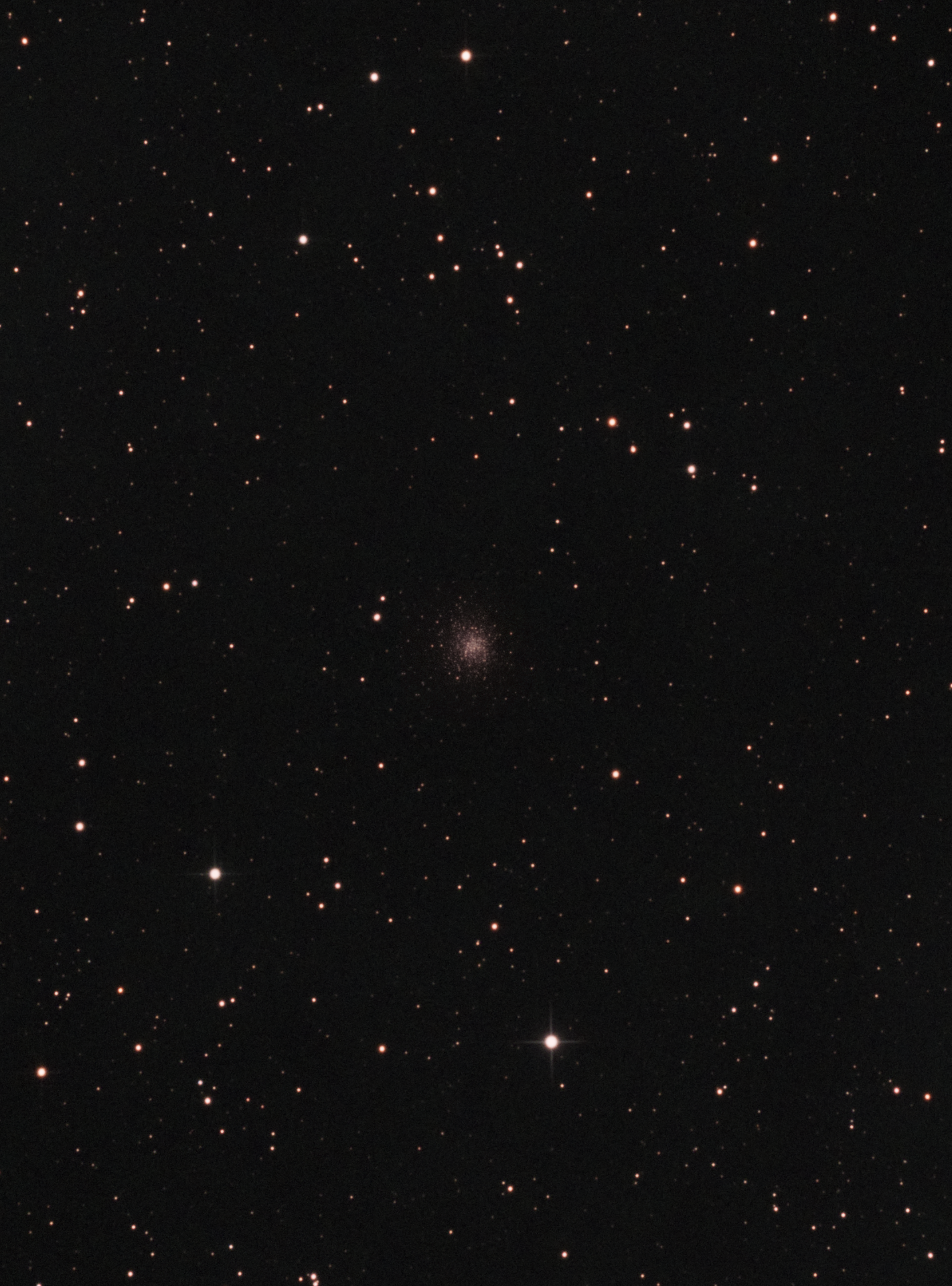
Palomar 2 & Pal 2 with the Hubble (Jan. 2022)
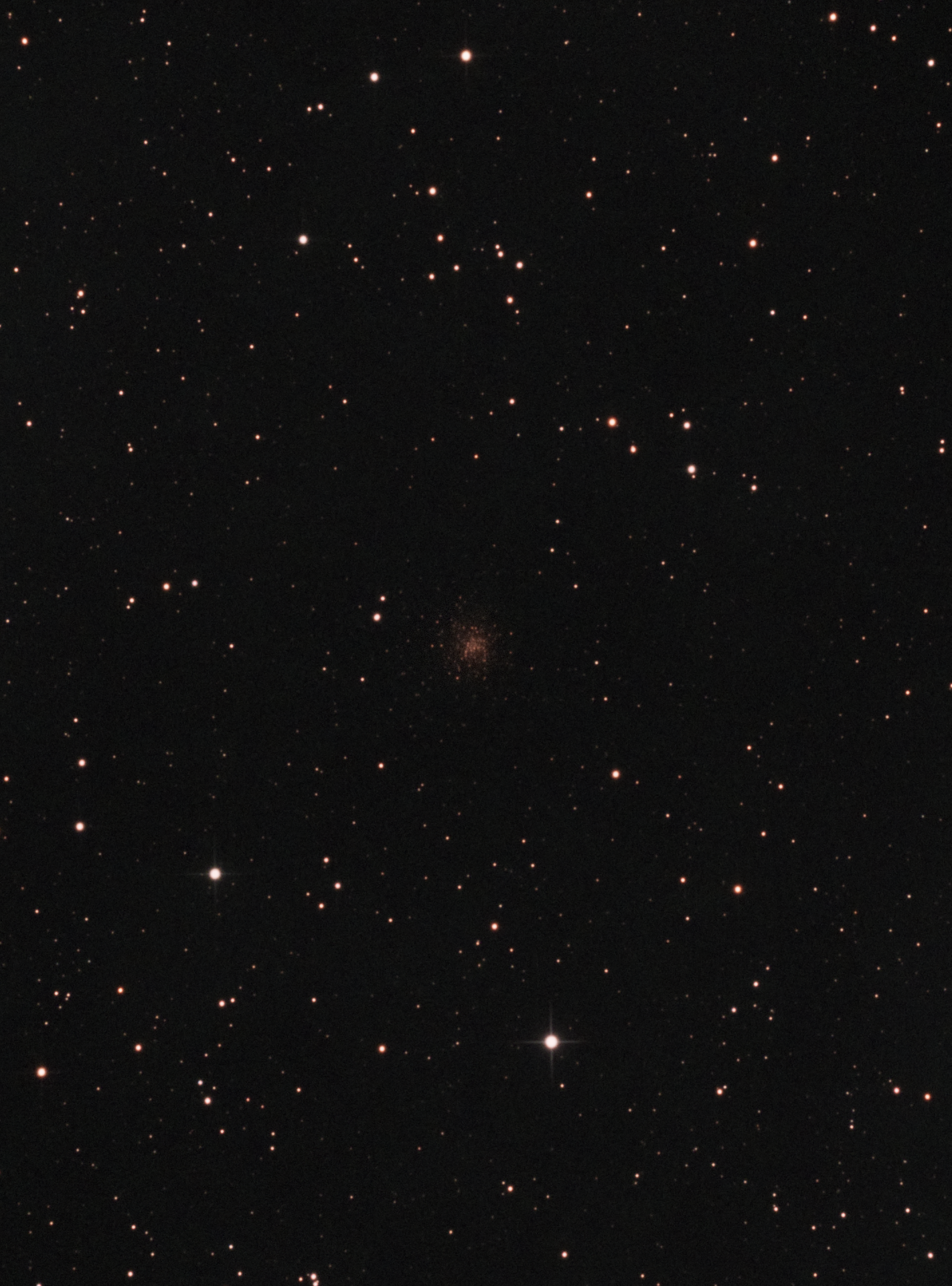
Palomar 2 is 34 kiloparsecs from the galactic center, one of the most far-flung globular clusters. That makes it about 26 kpc (+-4) from us (about 85,000 light years). That is why Pal 2 looks so small.
Another obstacle makes Pal 2 hard to study: the cluster sits behind a cloud of dust, and the cloud is not uniform but covers different parts of the cluster differently. The cloud makes it hard to obtain reliable star magnitudes. A 2020 study (Bonatto & Chies-Santos) says the cloud "leads to severe photometric scattering related to differential reddening." 2689. But the study heroically sorts through Hubble data to reach an informed estimate of the cluster's distance. (The study also gives the best current color-magnitude diagram for Pal 2.)
The same study at 2693 posits that Pal 2 contains 140,000 stars. Too bad it's so far away. It would be stunning to see it close up.
This image is 21x900" with the Atik 460EXC through the 203mm Synta ONTC Newtonian at f/4.9 using an Astronomik CLS filter.
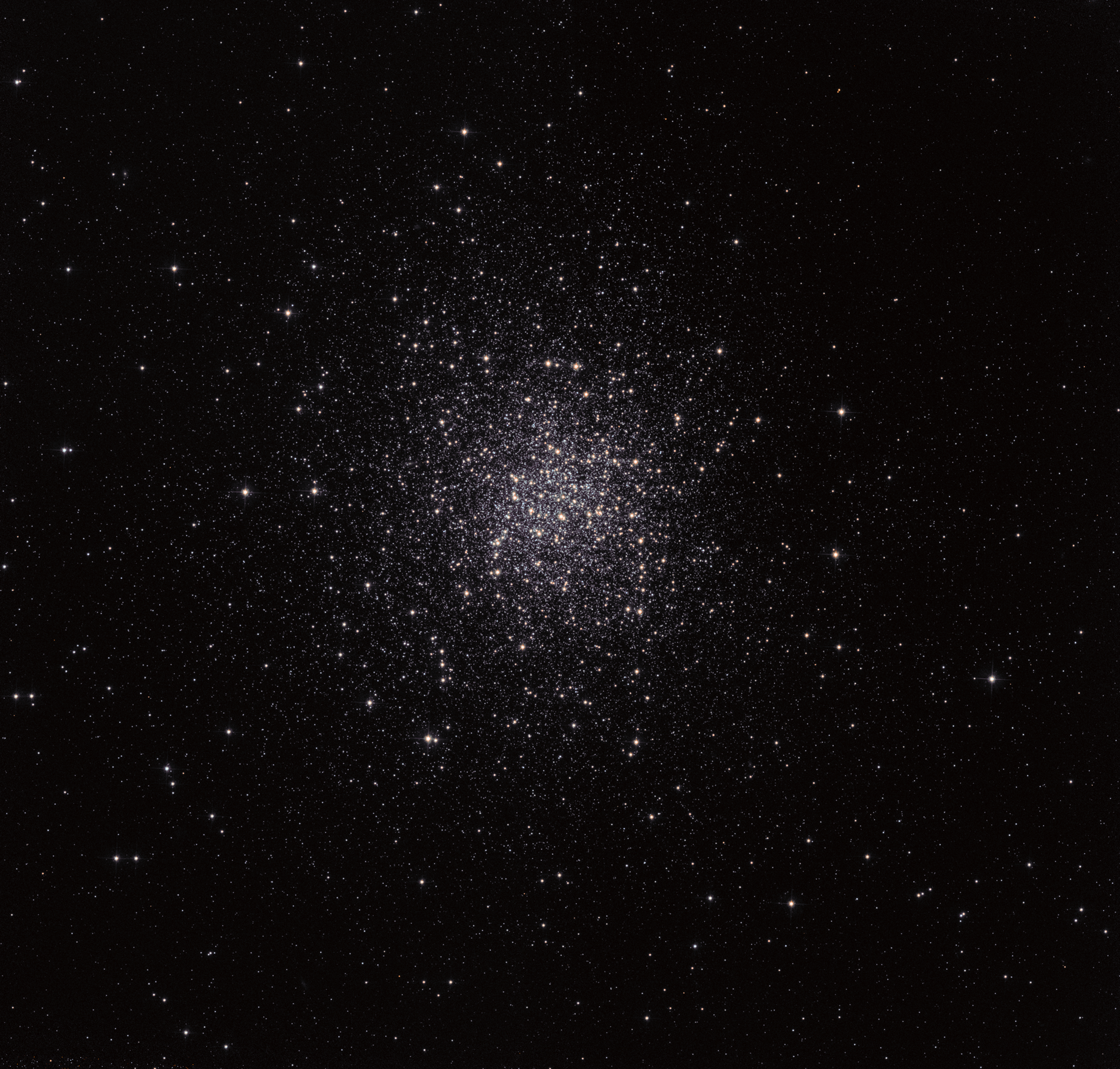
But---there is Hubble data, as the study says, so I went to Hubble's Legacy Archives and fetched it. It was taken in deep red and broadband, so the colors below are just a good guess. Once I had the Hubble data, I figured, hey, why not add it to my image? So here first is my image with the Hubble data added in---my collaboration with the Hubble on Pal 2. You can see the stars are a lot brighter. I can reach mag 20 from my backyard in one night, but the Hubble data goes down to mag 25 or so. Adding this to my data makes the cluster a lot brighter, though shrinking the Hubble scale to fit my images more or less means that that data shows only the brighter stars and clumps, so the Hubble data does not really add stars to my data as much as it makes everything brighter.
And here is my version of the Hubble data from the Hubble Legacy Archives:
Subscribe to:
Posts (Atom)