
.jpg) Here is M109, a galaxy said to be 55 million light years away in the direction of the Big Dipper or Ursa Major. In fact, M109 from our line of sight sits right next to one of the stars in the bottom of the dipper. This image is 69x30" with the Atik 16 through the Vixen R135S, unguided on the Tak EM-10, processed in Nebulosity and PS Elements 7. The sky was not quite as good as the night before, but it's always great to be under the stars.
Here is M109, a galaxy said to be 55 million light years away in the direction of the Big Dipper or Ursa Major. In fact, M109 from our line of sight sits right next to one of the stars in the bottom of the dipper. This image is 69x30" with the Atik 16 through the Vixen R135S, unguided on the Tak EM-10, processed in Nebulosity and PS Elements 7. The sky was not quite as good as the night before, but it's always great to be under the stars.
Astronomy and astrophotography by Val Ricks for the love of the sky and its Creator. For a better view, toggle F11 and turn off the lights.
May 20, 2009
M109 (5-19-09)
Here is M109, a galaxy said to be 55 million light years away in the direction of the Big Dipper or Ursa Major. In fact, M109 from our line of sight sits right next to one of the stars in the bottom of the dipper. This image is 69x30" with the Atik 16 through the Vixen R135S, unguided on the Tak EM-10, processed in Nebulosity and PS Elements 7. The sky was not quite as good as the night before, but it's always great to be under the stars.

May 19, 2009
Abell 39 (5-18-09)
.jpg) This planetary nebula is a stretch for my equipment (well, especially without guiding). Abell 39 is a rather dim planetary nebula discovered in 1966. A planetary nebula forms when an aging star expels its outer layers. The nebula has a diameter of about 5 light years and is 7,000 light years away. Can you see it? It is near the top of the frame. It is very dim. You may have to turn the lights off to see it. What I like most about this nebula is that it is nearly round. How amazing to look out in the sky and see this ball of light, faint as it is. Several background galaxies can also be seen.
This planetary nebula is a stretch for my equipment (well, especially without guiding). Abell 39 is a rather dim planetary nebula discovered in 1966. A planetary nebula forms when an aging star expels its outer layers. The nebula has a diameter of about 5 light years and is 7,000 light years away. Can you see it? It is near the top of the frame. It is very dim. You may have to turn the lights off to see it. What I like most about this nebula is that it is nearly round. How amazing to look out in the sky and see this ball of light, faint as it is. Several background galaxies can also be seen.For a really amazing image of this same nebula, see here. Notice in the linked image that one background galaxy is visible right through the nebula itself! You can see that galaxy in my image, too, but it's just a smudge, not as obvious.
This image is 173x30" with the Atik 16 through the Vixen R135S, unguided on the Tak EM-10.
M51 (5-18-09)
.jpg) So I have some success autoguiding and then the next night out the computer refuses to talk to the mount. It's a cable problem, I believe. So this is M51, unguided.
So I have some success autoguiding and then the next night out the computer refuses to talk to the mount. It's a cable problem, I believe. So this is M51, unguided.The image is 115x30" unguided on the EM-10, taken with the Atik 16 through the Vixen R135S, processed in Nebulosity 1 and Photoshop Elements 7.
May 15, 2009
M3 (5-14-09)
.jpg)
This is it: first real light for the new mount and first real autoguided image (well, worth publishing). M3 is a globular cluster in the constellation Canes Venatici, which last night passed directly overhead between 11 and 1. M3 is 33,900 light years from us and has perhaps half a million stars. This image is 48x2' through the Vixen R135S with the Atik 16, darks subtracted, autoguided on the Takahashi EM-10 with PHD through the DSI Pro. Wow! Processing was done in Nebulosity 1, Photoshop Elements 7, and Canon's Digital Photo Professional.
A New Mount and Autoguiding
I am happy to report the acquisition of a new mount, a Takahashi EM-10. This mount is used, about 9 years old, but its previous owner took great care of it, and it is built to last. Compared with other mounts I have used, it seems like a work of art. Everything fits so well and is finely finished. The hardwood tripod is beautiful.
Ever since the mount arrived a few weeks ago, we have had soupy weather. Every night has been cloudy, and if the clouds cleared off for a few hours at night the skies were hazy with water vapor. I took the mount out twice last week hoping to get the mount to autoguide, but just as I really came close to figuring out what was going on, the sky clouded over! So, finally, last night the sky cleared--not well, it's still pretty hazy, but clear enough to set up the mount, start Stark Labs' PHD autoguiding software, and figure out how to autoguide this mount. Success!
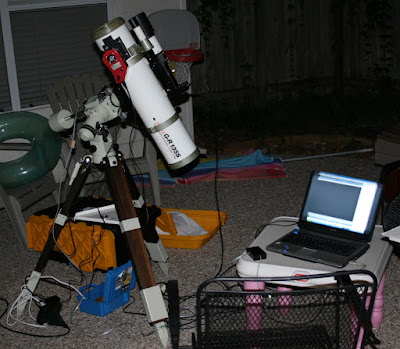
Autoguiding is basically the use of a second camera to create a feedback loop with the mount and a computer. The mount is already tracking the stars by motor pretty well. The guiding camera takes an image of the stars, sends it to a computer, and the computer sends commands to the mount. If the mount does not track the star exactly, the computer sends a correcting command to the mount to get it back on course. The guide camera tonight, a DSI Pro, was taking consecutive 3.5 second images through a 60mm f/5 achromat refractor mounted sturdily on the back of my Vixen R135S. The image from the guide camera was monitored by PHD, which sent correcting commands to the EM-10. I've had glitches before tonight (all of them generated by my own ignorance or carelessness), but finally everything came together.
Hooray! Let the fun begin! First target: M3 (which was approaching the zenith).
Ever since the mount arrived a few weeks ago, we have had soupy weather. Every night has been cloudy, and if the clouds cleared off for a few hours at night the skies were hazy with water vapor. I took the mount out twice last week hoping to get the mount to autoguide, but just as I really came close to figuring out what was going on, the sky clouded over! So, finally, last night the sky cleared--not well, it's still pretty hazy, but clear enough to set up the mount, start Stark Labs' PHD autoguiding software, and figure out how to autoguide this mount. Success!
Autoguiding is basically the use of a second camera to create a feedback loop with the mount and a computer. The mount is already tracking the stars by motor pretty well. The guiding camera takes an image of the stars, sends it to a computer, and the computer sends commands to the mount. If the mount does not track the star exactly, the computer sends a correcting command to the mount to get it back on course. The guide camera tonight, a DSI Pro, was taking consecutive 3.5 second images through a 60mm f/5 achromat refractor mounted sturdily on the back of my Vixen R135S. The image from the guide camera was monitored by PHD, which sent correcting commands to the EM-10. I've had glitches before tonight (all of them generated by my own ignorance or carelessness), but finally everything came together.
Hooray! Let the fun begin! First target: M3 (which was approaching the zenith).

April 23, 2009
Lunar Occultation of Venus (4-22-09)
4900.JPG)
4933.JPG)
4968.JPG)
4968Closer.JPG)
5017Smal.JPG)
5031-.JPG)
5035.JPG)
5035Closer.JPG) The occultation occurred for me around 7:25 am on 4-22-09. The images were taken with a Canon XTi through a Canon 50mm f/1.8, a Nikon 200mm f/4, and a Meade AR6. Some of these images were published at Spaceweather.com (see the link here or go directly to here).
The occultation occurred for me around 7:25 am on 4-22-09. The images were taken with a Canon XTi through a Canon 50mm f/1.8, a Nikon 200mm f/4, and a Meade AR6. Some of these images were published at Spaceweather.com (see the link here or go directly to here).

April 1, 2009
The Heart of the Beehive Cluster, M44, & IC 2388
.jpg)
This image is the heart of the Beehive Cluster, M44, in the constellation Cancer. This cluster of stars is very close (around 500 to 610 light years). If you look up a bit behind Leo's tail late in the evening in the spring in dark skies, you can see M44 as a patch of light mist or fog. Galileo turned his telescope on the mist and found it was actually many stars, close together.
Sue French's column in the March 2009 issue of Sky & Telescope pointed out that a number of faint background galaxies can be seen in large telescopes peaking out behind the Beehive. This narrow images contains only one, IC 2388. Does it look like it has a different shape than the stars in front of it? I see an ellipse oriented lower left to upper right. You may have to turn out the lights to see its faint shape, but then, you are stargazing!
This image is only 10x20". I was making sure my scope was in focus and waiting until Palomar 4 rose higher in the sky.
Subscribe to:
Posts (Atom)