Showing posts with label M51. Show all posts

April 2, 2025

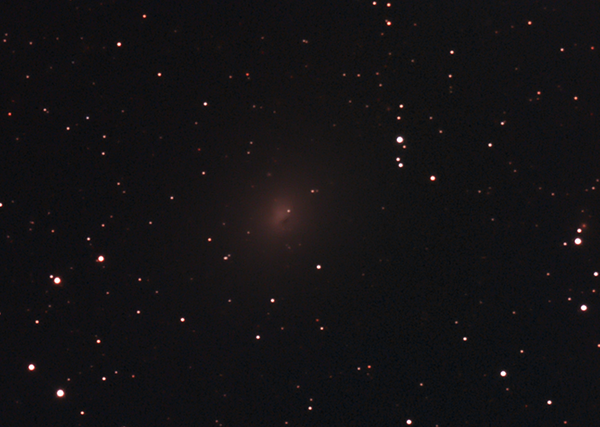
M51 after months of change, work, and clouds, March 2025


Here is a quick M51, just 10x5' with the Player One Uranus C Pro camera and Baader MPCC II-corrected 203mm Synta-ONTC Newtonian.  About two years ago, my old camera broke; a year ago, I replaced my laptop; and six months ago, I bought a CMOS camera.  My long-time capture app, Nebulosity, is no longer updated and will not work on the new laptop.  So I've begun using SharpCap Pro for the new camera, and it works fine, but the learning curve has been tough to climb while working full-time and any number of wonderful family events.  (Also, I've been working through the Herschel 400 list visually, and that has definitely taken some nights.) The resolution with the C Pro and the Newt is very high: 0.595" per pixel, higher than any other setup I've used.  My seeing will not be up to it on some nights; I'm still thinking around that.

March 31, 2021

M51 & NGC 5195 (Winter 2021)

I've never finished off an image of M51 and NGC 5195, despite their traveling almost overhead, until now.  Here is 18.75 hours with the Atik 460EXC through the 203mm Synta-ONTC Telescope at native f/4.95, Baader MPCC, and Astronomik CLS filter.  This is four different nights of data.

Several smaller galaxies are apparent in the image.  At the bottom left is UGC 8470, a spiral galaxy 125 million light years away.  At the top, in the middle, above a trio of brighter stars, is IC 4282, mag. 17.4, actually twin galaxies something like M51 and NGC 5195, at 635 million light years.

Just above NGC 5195 two galaxies lurk.  One is brighter, on the left, and one is long and thin, on the right.  The brighter one is IC 4278, and the long, thin one is IC 4277.  The brighter IC 4278 is 230 million light years away.  The long, thin IC 4277, despite appearing in most images of M51, is something of a mystery.

April 18, 2018

M51 and NGC 5195 (April 2018)


Just another M51 and companion galaxy NGC 5195.  The grand spiral M51 lies perhaps 25 million light years from here.  M51 appears to be quite a bit smaller than our own galaxy. The companion, NGC 5195, is interacting with M51.  These two always amaze visually as well.

This image is 26x480" with the SXVF-H9 through CFF 290 Classical Cassegrain at f/8.1 and an Astronomik CLS filter.

January 28, 2017

M51 (May 2016)


This is another set of Luminance subs from DSW, 24x900" plus 1x1200".  Of course, I've imaged this before, but this is the deepest data I've processed.  This image is about 80% of full size because I wanted it to sort-of fit on the screen.  Notice the numerous little galaxies in the background, and some galaxy clusters.

June 13, 2014

M51 (April 29, 2014)


I know---I don't need another image of M51.  But I had a few hours and wanted to use the refractor.  I always like the look of stars taken through it.  Of course, with the H9C the scope is working far below full resolution.  And I seemed to get a lot of red in the galaxy.  Perhaps the sky was more transparent to Ha, or perhaps it was particularly opaque to blue.  Either way, here is the result.

Telescope: Astro-Tech AT111EDT and William Optics AFR-IV (eff. at f/5.6)
Camera and Exposure: SXVF-H9C 20x600"), Alnitak Flat-man flats
Filter: Astronomik CLS
Guiding: SX Lodestar and SX OAG
Mount: Takahashi NJP
Software: Nebulosity, Photoshop CS3
Location: The Woodlands, TX

March 8, 2013

A Short M51 (Jan. & Feb. 2013)

How many images of M51 can a fellow have?  This was taken while I still had night left after my real target had set behind the trees.  Size reduced a bit to handle noise in the background.

Telescope: Astro-Tech AT111EDT and William Optics AFR-IV (eff. at f/5.6)
Camera and Exposure: SXVF-H9 (23x480"), Alnitak Flat-man flats
Filter: Astronomik CLS
Guiding: SX Lodestar and SX OAG
Mount: Takahashi NJP
Software: Nebulosity, Maxim DL, Photoshop CS3
Location: The Woodlands, TX

August 25, 2012

NGC 185, M51, M16 - Smalls

We've had clouds and clouds lately.  I'm starting to chew on old data.  Two are new images to the blog, however.
This is NGC 185, a satellite galaxy of the great Andromeda Galaxy, M31.  NGC 185 appears to be full of older, yellow stars and not much action, but a dark lane also appears across the galaxy's face.  Astronomers looking very closely have discovered blue star clusters in the galaxy.  There is new stellar life there yet!  I believe I took this image with the Orion ED80 in January, 2010.

M51 is a spiral galaxy that is best positioned for imaging in winter and spring.  This is a re-process of data gathered with the Orion 10" f/4.7 Newtonian in March of 2011.

This is my last data from Three Rivers.  The nebula is M16, the Eagle Nebula.  The eagle shape is hard to see in the image, as the data is not deep.  But if you look closely you can see in the heart of the nebulosity the pillars of creation made famous by the Hubble Space Telescope.  This image was shot with the SV80ED, mounted on the EM-10, unguided.  It is a stack of forty 3-minute images.

All of these images were taken with the SXVF-H9C.

March 12, 2011

M51 (3-11-2011)

M51 is such a beauty, and so interesting. It's a favorite target for imagers. This is 105x150" with the 10" f/4.7 newt, Baader MPCC, IDAS-LPS-P2 filter, and SXVF-H9C camera. The subs were short both because they did not need to be any longer (the histogram was moved well off of the left side) and because I have not sorted out all the flex in this system and that's as long as they could be without using the off-axis guider. I still have not figured out how to make the OAG hold the weight of the camera, so I was using a guidescope. I threw out only three subs. This image is probably about what I can do from the burbs, at least in one night. I've taken a couple of images of this galaxy before, when I knew less of what I am doing.

May 19, 2009

M51 (5-18-09)

So I have some success autoguiding and then the next night out the computer refuses to talk to the mount. It's a cable problem, I believe. So this is M51, unguided.

The image is 115x30" unguided on the EM-10, taken with the Atik 16 through the Vixen R135S, processed in Nebulosity 1 and Photoshop Elements 7.