May 28, 2013
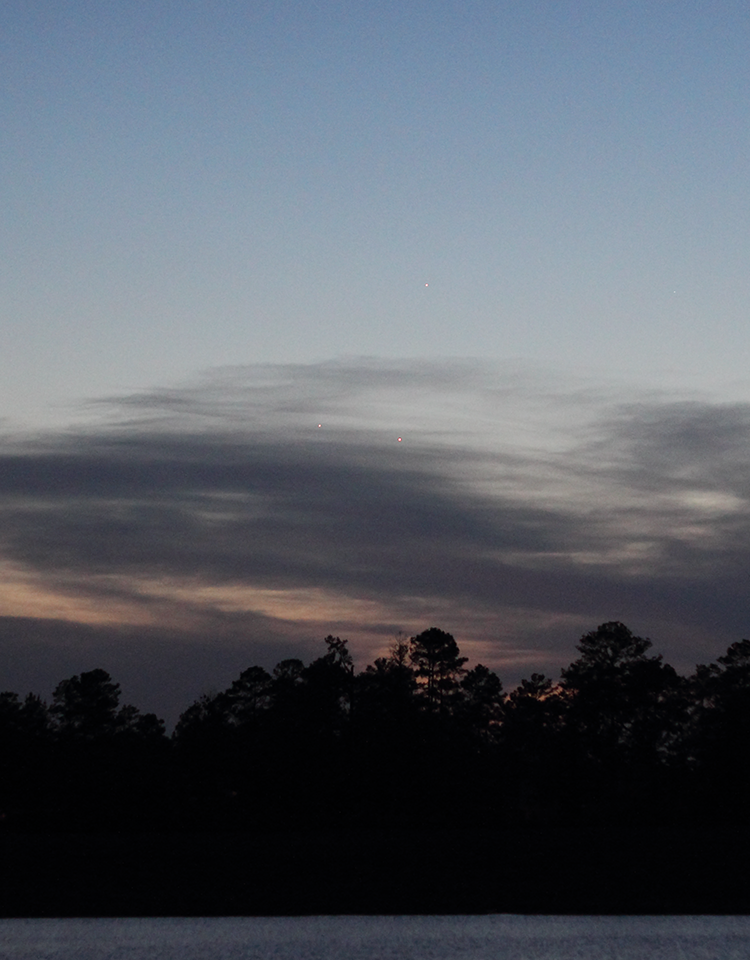
Planetary Alignment, May 27, 2013
May 1, 2013
M3 (April 19, 2013)
This globular cluster, known as M3 or Messier 3, brightens the sky in the constellation Canes Venatici. It is roughly 33- to 39,000 light years away. Globs are interesting, and they become more interesting the deeper one can see into them. They contain so many stars that no telescope from earth could see them all. One can always go deeper! Yet deeper images and larger telescopes make the objects fascinating.
Telescope: Astro-Tech AT111EDT and William Optics AFR-IV (eff. at f/5.6)
Camera and Exposure: SXVF-H9 (RGB: 6:6:6 x 300" (1.5 hours)), Alnitak Flat-man flats
Filter: Astronomik RGB
Guiding: SX Lodestar and SX OAG
Mount: Takahashi NJP
Software: Nebulosity, Maxim DL, Photoshop CS3, Registar
Location: The Woodlands, TX
Telescope: Astro-Tech AT111EDT and William Optics AFR-IV (eff. at f/5.6)
Camera and Exposure: SXVF-H9 (RGB: 6:6:6 x 300" (1.5 hours)), Alnitak Flat-man flats
Filter: Astronomik RGB
Guiding: SX Lodestar and SX OAG
Mount: Takahashi NJP
Software: Nebulosity, Maxim DL, Photoshop CS3, Registar
Location: The Woodlands, TX
AT65EDQ Test Image (April 20, 2013)
Here is a test image taken through a new AT65EDQ. This image was taken with the SXVF-H9C, a one-shot-color camera; you can see the color correction of the lens system is excellent. I'm still trying to determine whether to swap out the stock focuser. It held the equipment well but does not have the precision I'm used to. Focus was a bit less snappy than I'm used to, too, and I'm not sure why. But the image looks promising.
This is a bit over an hour (23x180"). Clouds were rolling in, and the moon was out. The cluster is M13, of course. I was anxious to see how stars looked in the corners of the full frame (small though this chip is), so I did not even bother to center the cluster.
April 20, 2013
NGC 4631, the Whale Galaxy and the Remora (March & April, 2013)
The galaxy immediately above the Whale is NGC 4627. Probably the two are interacting gravitationally, and this may explain the asymmetrical appearance of each. Together they are cataloged as #281 in Halton Arp's Atlas of Peculiar Galaxies. I'd say if NGC 4631 is the Whale Galaxy then NGC 4627 is the Remora.
The image itself has a peculiar shape. I took two sets of sub-frames, one in March and one in April. The camera was placed at a slightly different angle with respect to the telescope in March than in April. So I had edge lines in the final image. Normally, I would crop all those out, but I wanted to show all of the little galaxies floating about in this part of the sky, especially the irregular galaxies, so I selected around all of them, then added a darker layer outside of the selection. Exploring in this image is pretty fun. You might compare the full resolution image to what is shown for this area in sky-map.org, linked at right. The dimmest stars in this image are magnitude +18.5.
Telescope: Astro-Tech AT111EDT and William Optics AFR-IV (eff. at f/5.6)
Camera and Exposure: SXVF-H9 (104x480" (13.86 hours)), Alnitak Flat-man flats
Filter: Astronomik CLS
Guiding: SX Lodestar and SX OAG
Mount: Takahashi NJP
Software: Nebulosity, Maxim DL, Photoshop CS3
Location: The Woodlands, TX
April 6, 2013
NGC 3628 (Dec. 2012 - Feb. 2013)
My best visual view of the galaxy was through an 8" Newtonian reflector from a dark site at 40x magnification. The galaxy was a long, ghostly glow with a dark lane down the center—quite a stunning sight! This image is just luminance.
Telescope: Astro-Tech AT111EDT and William Optics AFR-IV (eff. at f/5.6)
Camera and Exposure: SXVF-H9 (108x480" (14.4 hours)), Alnitak Flat-man flats
Filter: Astronomik CLS
Guiding: SX Lodestar and SX OAG
Mount: Takahashi NJP
Software: Nebulosity, Maxim DL, Photoshop CS3
Location: The Woodlands, TX
March 19, 2013
M109 (March 11 and 12, 2013)
Telescope: Astro-Tech AT111EDT and William Optics AFR-IV (eff. at f/5.6)
Camera and Exposure: SXVF-H9 (24x900" for M109 and 17x900" for everything else---I had some sort of glow in 7 frames that did not cover the galaxy), Alnitak Flat-man flats
Filter: Astronomik CLS
Guiding: SX Lodestar and SX OAG
Mount: Takahashi NJP
Software: Nebulosity, Maxim DL, Photoshop CS3
Location: SHSU Observatory near Huntsville, TX; Starry Nights Bed and Breakfast near Wimberley, TX
March 15, 2013
M81 (March 11 & 12, 2013)
This image was taken from skies darker than my normal location. Distant galaxies are always better seen from darker skies. The image is shrunken slightly for noise reduction.
If you look closely at the image above, you will see there are clouds to the left of M81 running from the top to the bottom of the image. These are probably clouds of gas and dust within our own galaxy and have earned the name "Galactic Cirrus." See here and here. These clouds are very dimly lit. They are more easily seen in this inverted version:
Telescope: Astro-Tech AT111EDT and William Optics AFR-IV (eff. at f/5.6)
Camera and Exposure: SXVF-H9 (29x900"), Alnitak Flat-man flats
Filter: Astronomik CLS
Guiding: SX Lodestar and SX OAG
Mount: Takahashi NJP
Software: Nebulosity, Maxim DL, Photoshop CS3
Location: SHSU Observatory near Huntsville, TX; Starry Nights Bed and Breakfast near Wimberley, TX
Subscribe to:
Posts (Atom)