Showing posts with label SXVF-H9. Show all posts

August 28, 2021

Crescent Close-Up (NGC 6888) (August 2021)


I love using my CFF 290 Classical Cassegrain.  Here is an image taken (at f/8.1, 2350mm) of the brighter half of the Crescent Nebula in Cygnus.  This is a full narrowband image.  I took three hours of H-alpha then spent a night on what I thought was O3 but which turned out to be S2---ouch (slip of the brain when controlling the filter wheel)!  The S2 is blended in here.  I finally caught another 3 hours of O3.  Total time: 8 hours 50 minutes.  The H-a and S2 subs were 20 minutes long; the O3's were 30 minutes each.

After I finished the O3 subs and the Crescent slipped behind the trees, I put a diagonal and eyepiece in the big scope and enjoyed a tour of Cygnus.  Highlights included the Owl Nebula and Phi And (0.5" clean split; truly awesome to see those little diffraction patterns so close together).  As always, the scope performed like a champ.  I started observing at 3:30 a.m. and made myself put it away at 5.  I had to sleep sometime.

April 17, 2020

NGC 3953 (April 2020)


OK, so this is a galaxy just southeast of the Big Dipper's bowl.  It looks a lot like M109 and might actually be the galaxy discovered that we now call M109 (whose position was disputed for a long time).  NGC 3953 is a lovely spiral about 61 million light years away.

The image is a time machine looking back into the past.  Find the following beginning at NGC 3953 in the center:

Two galaxy lengths down and left, PGC 37256. No idea how far this one---perhaps it is near NGC 3953.

Above and a little left of NGC 3953, PGC 213900, mag 16.76, 710 million light years.

Below and a little right, PGC 2412642, mag 16.58, 710 million light years.

Immediately left of the galaxy, the small, horizontal "seed" shape, PGC 213899, mag 17.84, 340 million light years.

Below the galaxy, nearly at the bottom of the frame, PGC 2411483, mag 17.30, 970 million light years.

Directly far left of NGC 3953, elliptical, PGC 2407838, mag 17.85, 1.4 billion light years.

In the upper left corner, there are three galaxies.  Beginning at lower left, PGC 2406768, mag 16.69, 1.2 billion light years. Directly above that, PGC 2406922, mag 18.26, 1.2 billion light years. To the right and above that, PGC 2408846, mag 17.87, 1.6 billion light years.

In the bottom right, 1 galaxy length in from the bottom and 1 from the right, PGC 2415838, mag 17.96, 1.7 billion light years.

This image is 49x360" through a light pollution filter.


April 15, 2020

NGC 2841 (Jan. 2020)

NGC 2841 is found in Ursa Major, mostly down the bear's front leg.  Apparently this galaxy, about 46 million light years distant, is 150,000 light years across, half again larger than our own galaxy.

This image is 34x360" with the 203mm f/4.9 Synta-ONTC Newtonian telescope and the SXVF-H9 camera.

April 2, 2020

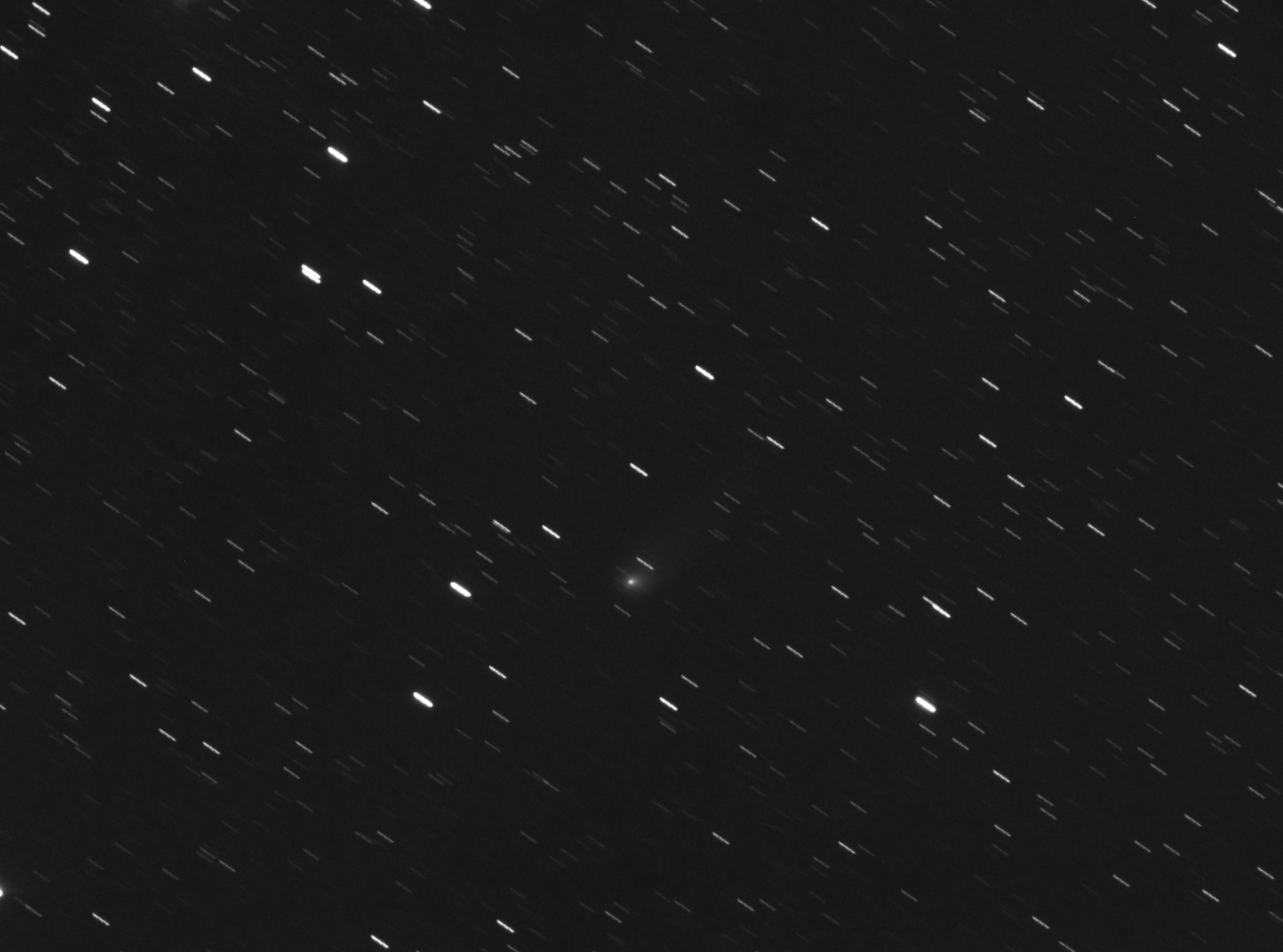
Comet C\2019 Y4 (ATLAS) (1:37-1:58 UTC on 4-1-2020)

And a single frame taken at 1:44 UTC:
Taken with the SXVF-H9 through the Synta-ONTC 203mm Newtonian at f/4.9.  Each exposure was 30 seconds through an Astronomik CLS filter.

February 6, 2020

Galaxies behind M44 (Feb. 2020)

This is part of M44.  M44 is a cluster of stars just 610 light years away, and this is just a small part.  I've always found M44 intriguing through the camera: behind the cluster, peeking through its stars, are lots of little galaxies.  Some of these are far away.

The two bright galaxies sitting perpendicular to each others are PGC 24284 (horizontal) and PGC 2800946 (vertical).  PGC 2800946 is 16th magnitude, and about 220 million light years away.  At that distance, the galaxy is about 62,000 light years across.  PGC 24284 (horizontal) is about the same distance, maybe 5 million light years closer, and actually just a little larger than its companion.

Behind these two, though, other galaxies lurk.  Among them I see PGC 4172192, 1.8 billion light years away (mag. 18.18); PGC 4172171, 2.6 billion light years (mag. 18.44); PGC 4172165, 1 billion light years (Mag. 18.57); and PGC 3732412, 2 billion light years (blazing away at mag. 17.65).

Among these, I see a couple of galaxies for which I have no name.  I was unable to find them on any chart I have.

The dimmest stars in the image are less than mag. 19.  The brighest star in the image is TYC 1395-2047-1, magnitude 10.86.

This image is 7x720" with the CFF 290mm f/13.5 Classical Cassegrain reduced to f/8.1.  The camera was the SXVF-H9, and the subs were taken through an Astronomik CLS filter.  Galactic stats were taken from SkySafari.

February 3, 2020

NGC 3344 (February 2020)


This galaxy is only about 30 million light years away.  It is a grand spiral in shape but only about 65,000 light years across, about 2/3rds the size of our Milky Way.

There are several smaller galaxies—9 of them!in the image along the right side of NGC 3344.  Most are around 770 million light years away, give or take thirty million.

The dimmest stars in the image are about magnitude 19.

On the night I took these frames, the seeing was not great.  At the resolution of the system I used, I could only shoot within 22 degrees or so of zenith.  This image was shot at a scale of 0.566 arcsec/pixel.  The image covers 12.8 x 9.72 arc minutes of sky.  I used 9x720" subframes taken with the SXVF-H9 camera at an effective focal length of 2,350mm.  The telescope used was the CFF 290 f/13.5 Classical Cassegrain.  The camera shot through an Astronomik CLS filter.

January 11, 2020

Sharpless 2-228 in Auriga (Dec. 2019)


This splash of glowing hydrogen is a sign of greater things to come.  Barely visible to the eye through large telescopes, this nebula is spawning stars.  Hidden in its dusty glow is a cluster of new stars waiting to be seen!

This image shows (i) the glowing gas of ionized hydrogen (6.5 hours of exposure) and (ii) stars and a little gas shining at the wavelength of ionized oxygen (5 hours of exposure).  But professional astronomers with access to infrared telescopes that peer through the dust and gas have taken images of the cluster of stars glowing within the cloud.  Here is a link to the infrared image of the hidden cluster.  Here is the study that produced the infrared image of the hidden cluster.

My image was taken with the Synta-ONTC 203mm Newtonian telescope at f/4.95 and the SXVF-H9 camera.  What amazing things we can see from our own backyards!

January 6, 2020

NGC 1931 (Sh2-237) in H-alpha (December 2019)

This is the h-alpha stack, 6.5 hours worth.  The area is fun because it is actually covered with h-alpha, the glow of ionized hydrogen.  Studies of NGC 1931 suggest that two clouds of gas collide here, actually generating two swarms of stars.  You can see the bow shock of one of the clouds moving towards the other.

December 16, 2019

NGC 1491 (2018-19)


This is 21/9/6x1800" in Ha/O3/S2, for a total of 18 hours.  One version is processed to give something like natural colors in the nebula, and the other is processed in something like the Hubble palette.  Both are merely narrowband images.  Camera was the SXVF-H9.  Telescope was the Synta-ONTC Newtonian at f/4.95.  Mount: Takahashi NJP. Data was gathered in 2018 and 2019.

December 9, 2019

NGC 896 Hubble Palette (Nov. & Dec. 2019)

I was able to collect SII, so here is a version in Hubble palette.  This is now 11/8/10x1800" in Ha/O3/S2, for a total of 14.5 hours of exposure.  Taken with the SXVF-H9 through Astronomik filters through a Baader MPCC Mk II and Synta-ONTC Newtonian telescope, guided on a Takahashi NJP.

November 27, 2019

NGC 896, the Fishhead Nebula in H-a and O3 (Nov. 2019)

This is a two-color with a synthetic green channel added.  To the H-a below, I added 8x1800" in O3.  Telescope was the 203mm Synta-ONTC Newtonian at f/4.95.  Camera was the SXVF-H9.

November 21, 2019

Comet 2017T2 Panstarrs on 11-16-2019 from 9:22-9:46 UTC


This is 20 minutes through an Astronomik CLS filter on Comet 2017T2 Panstarrs early in the morning of 11-16-2019.  The comet appeared in the constellation Auriga.  The brighter stars in the upper left are from Collinder 62, an open cluster the comet appeared to be passing.  Frames were taken with the SXVF-H9 and the 203mm Synta-ONTC Newtonian telescope at f/4.95.  The movie shows the comet moving among the stars during the 20 minutes of filming.  The lower image shows the comet frozen with the stars moving as streaks.  The point of the lower image is to show the extent of the comet's tale, which is not as visible in the movie.

November 19, 2019

NGC 896, the Fishhead Nebula (also IC 1795) (Nov. 2019)

11x1800" with the SXVF-H9 through the Synta-ONTC Newtonian telescope at f/4.95, Astronomik 6nm Ha filter, Baader MPCC (II). 

November 11, 2019

Cave Nebula, Hubble Palette (Oct.-Nov. 2019)

With the S2, we are now at 8, 9, 9 x 1800" for Ha, O3, S2, so 13 hours total.  Taken with the SXVF-H9 through the Synta-ONTC Newtonian telescope at f/4.95.

October 31, 2019

Cave Nebula Bi-color (Oct. 2019)

I was able to add 9x1800" in O3 to the 8x1800" I have in H-alpha.  The two were combined to create a synthetic green channel, then O3 was assigned to B and H-alpha to R.  The subframes were taken with the SXVF-H9 through my Synta-ONTC Newtonian telescope.

October 15, 2019

Sh 2-132 Hubble Palette (Sept.-Oct. 2019)

This is 16.5 hours of narrowband in equal amounts taken with the SXVF-H9 through the 203mm Synta-ONTC Newtonian at f/4.95.

October 5, 2019

Sh 2-132 Bi-Color (September 2019)

This image is 11x1800" in H-alpha and 11x1800" in OIII, taken with the SXVF-H9 and the Synta-ONTC 203mm f/4.95 Newtonian.

September 17, 2019

SH2-132 (Sept. 2019)


Honestly, I did not know this existed till I went looking for a target.  I noticed  some nebulosity on some pictures here: https://www.mdwskysurvey.org/.  I found the spot in SkySafari, determined there was something bright enough to catch in a night, and aimed the camera there.  There is quite a lot to see!  This is 11x1800" in H-alpha with the SXVF-H9 through the Synta-ONTC 203mm f/4.95 Newtonian.

IC 63 (Sept. 2019)


This is 11x1800" in H-alpha with the SXVF-H9 and the Synta-ONTC 203mm f/4.95.

June 18, 2019

Tulip Nebula, Sharpless 2-101 (June 2019)


The Tulip Nebula is an area of gas excited by a type O6.5 star, HD 227018, and some other type O stars nearby.  HD 227018 is the blue-white star just right of the nebula's center, the one that shows a bow-shock.  It's not the brightest star visually, but it's the hottest star, and its UV light ionizes the local hydrogen, making it glow.  It's the instigator of most of the glow you see here.

Notice that the blue star at the upper left has two sets of horizontal diffraction spikes.  It's a double star!  That's why.

This is two-color image, H-alpha (9x1800") and O-III (7x1800"), with a synthetic green channel constructed of the two colors.  I plan to collect SII when I can, to make a Hubble palette version.  The telescope was the Synta-ONTC 203mm f/4.95 Newtonian with Baader MPCC and the SXVF-H9 through Astronomik filters.