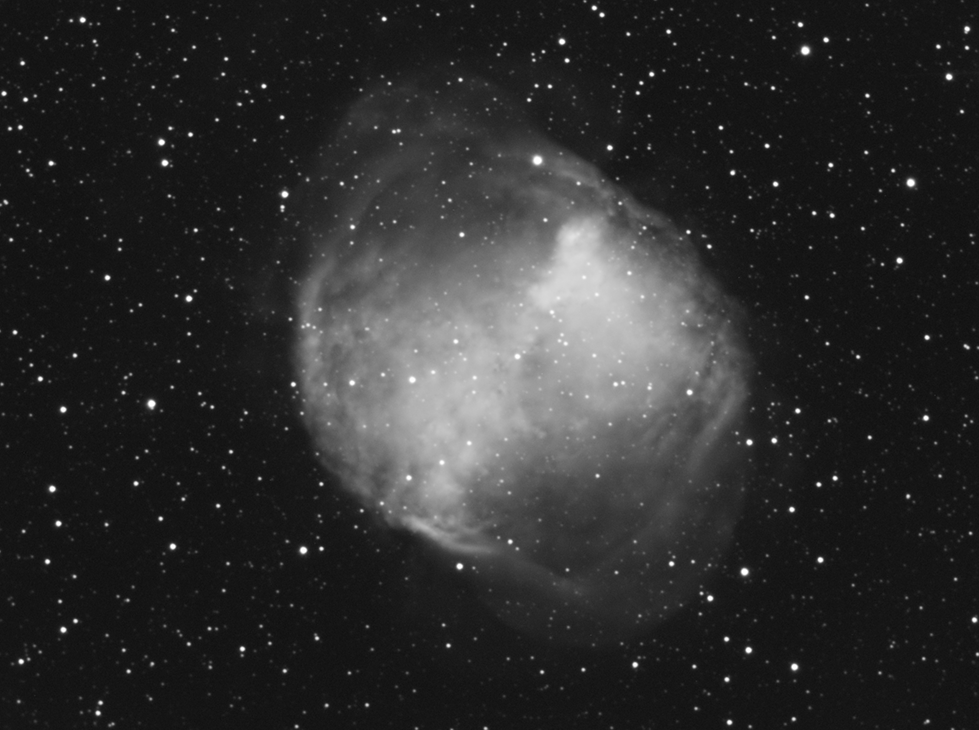
This data came from AG Optical. It was fun to process. Things clouded up in the Gulf Coast from May through the end of July this year. It's been crazy, so I'm glad to have some data to work on.
Showing posts with label M27. Show all posts
August 12, 2021
M27 in H-alpha (Summer 2021)
July 1, 2020
June 18, 2017
M27, Dumbbell Nebula (May 2017)
M27 is found in Vulpecula and is one of the best telescopic sights of summer. I have "discovered" it many times: most notably in 11x80 binoculars from the desert east of Reno and with an 80mm refractor in Bear Lake, Idaho. Here is what it looks like with a color camera from my backyard in The Woodlands, TX, with narrowband data added. I gathered 9x720" in H-alpha and 8x720" in OIII with the SXVF-H9 and combined this with 25x360" taken with the SXVF-H9C. Of course, this is the big scope, the CFF 290mm Classical Cassegrain, at an effective focal length of about f/8. The filters are Astronomik. Guiding was done with an SX-OAG on a Takahashi NJP.
May 10, 2017
M27 in OIII (May 5, 2017)
Here is M27 in OIII. This picture is a stark contrast from the H-alpha. The OIII emission is mostly what we see when we look at the nebula, which is very bright. My most memorable view of it was from very dark skies in Idaho through an 80mm refractor. Under such skies, M27 looks like a cotton ball hanging in space. This is 8x720" with the SXVF-H9 through an Astronomik 6nm OIII filter and the CFF 290 Classical Cassegrain.
May 2, 2017
M27 in H-alpha (May 1, 2017)
I've shot this target before, but never at this focal length in H-alpha. What intrigues me about this image is the motion. You can almost see the swirling of the central star as it shoots out energy—something is certainly spinning out radiation.
This image is 9x720" through an Astronomik 6nm H-alpha filter and the CCF 290 Classical Cassegrain (at about f/8) with the SXVF-H9 camera.
May 8, 2016
M57, M27, Palomar 14, NGC 5005, NGC 6210 (May 2016)
Last week we were blessed with three clear nights, and I was able to image on two of them! Here are the results. All were taken with the CFF 290 Classical Cassegrain at f/7.93. The Astro-Physics CCDT67 brings the effective focal length down from f/13.5 to almost exactly 2300mm. The camera is an SXVF-H9, and I shoot through an Astronomik CLS filter. Guiding is done with an OAG and SX Lodestar on a Tak NJP.
M57 is a favorite of mine. I was still up imaging when it rose high enough, so I thought I'd see what I could get. Now I'm excited to image it with a color camera at this focal length. I've never imaged at this focal length, of course. This image is 16x240". M57 is found in Lyra.
M27 is now also on the color list. Nice to see the close up view. This image is 11x360" and is shrunk to 70% of original because the seeing did not warrant the larger size. M27 is found in Vulpecula.
This is Palomar 14, a globular cluster floating well outside of the Milky Way Galaxy. It lies right in the middle of this image. It's brightest stars (one or two) are around magnitude 18, and I can find several in this image that are magnitude >19. Still, I can only count around 15 stars near the center of this image that I believe are cluster members, based on studies I have read. Palomar 14 is notoriously difficult to observe. The bulk of its stars are >22 magnitude. The cluster was discovered in 1958 on photographic plates. This image is just 10x600" and is inverted so that the very dim stars are easier to see. It could use another four hours, perhaps, and a darker location than my backyard. Palomar 14 is found in Hercules.
NGC 5005 is a galaxy in Canes Venatici. I like its grand spiral design, and I find a slight bar in the center, based on measurements of its brighter bulge. It's outer parts are very dim, and I have stretched the image to see them. Several other galaxies can be found in the image. This image is 17x720".
NGC6210 is a planetary nebula in Hercules. The image is just 4x4" + 25x8" = 216 seconds, just over three minutes. The nebula is quite bright. The faintest stars in the image are dimmer than magnitude 15.
M57 is a favorite of mine. I was still up imaging when it rose high enough, so I thought I'd see what I could get. Now I'm excited to image it with a color camera at this focal length. I've never imaged at this focal length, of course. This image is 16x240". M57 is found in Lyra.
M27 is now also on the color list. Nice to see the close up view. This image is 11x360" and is shrunk to 70% of original because the seeing did not warrant the larger size. M27 is found in Vulpecula.
This is Palomar 14, a globular cluster floating well outside of the Milky Way Galaxy. It lies right in the middle of this image. It's brightest stars (one or two) are around magnitude 18, and I can find several in this image that are magnitude >19. Still, I can only count around 15 stars near the center of this image that I believe are cluster members, based on studies I have read. Palomar 14 is notoriously difficult to observe. The bulk of its stars are >22 magnitude. The cluster was discovered in 1958 on photographic plates. This image is just 10x600" and is inverted so that the very dim stars are easier to see. It could use another four hours, perhaps, and a darker location than my backyard. Palomar 14 is found in Hercules.
NGC 5005 is a galaxy in Canes Venatici. I like its grand spiral design, and I find a slight bar in the center, based on measurements of its brighter bulge. It's outer parts are very dim, and I have stretched the image to see them. Several other galaxies can be found in the image. This image is 17x720".
NGC6210 is a planetary nebula in Hercules. The image is just 4x4" + 25x8" = 216 seconds, just over three minutes. The nebula is quite bright. The faintest stars in the image are dimmer than magnitude 15.
October 12, 2013
M27 Bi-Color Narrowband (Sept. & Oct. 2013)
M27 again. Early in the summer I took some OIII of this object, but the frames had a guiding error. They looked cool, though, so I've wanted to come back for more. Also, I observed M27 from Bear Lake, Utah, this summer through my SV80ED. It was stunning, a big cotton ball in the sky. Too bad the imaging had to wait until late September, when M27 is only available for a few hours from my backyard.
This is a bi-color image, which in this case means that I concocted a synthetic green channel out of the OIII (80%) and Ha (20%) frames. I opted to show OIII in blue rather than green (OIII is more green than blue) because red and blue look nicer to me than red and green.
Telescope: Astro-Tech AT111EDT and William Optics AFR-IV (eff. at f/5.6)
Camera and Exposure: SXVF-H9 (Ha+NII:13x1200"; OIII:9x1200"), Alnitak Flat-man flats
Filter: Astronomik Ha+NII & OIII
Guiding: SX Lodestar and SX OAG
Mount: Takahashi NJP
Software: Nebulosity, Maxim DL, Registar, Photoshop CS3
Location: The Woodlands, TX
This is a bi-color image, which in this case means that I concocted a synthetic green channel out of the OIII (80%) and Ha (20%) frames. I opted to show OIII in blue rather than green (OIII is more green than blue) because red and blue look nicer to me than red and green.
Telescope: Astro-Tech AT111EDT and William Optics AFR-IV (eff. at f/5.6)
Camera and Exposure: SXVF-H9 (Ha+NII:13x1200"; OIII:9x1200"), Alnitak Flat-man flats
Filter: Astronomik Ha+NII & OIII
Guiding: SX Lodestar and SX OAG
Mount: Takahashi NJP
Software: Nebulosity, Maxim DL, Registar, Photoshop CS3
Location: The Woodlands, TX
September 28, 2013
Dumbbell Nebula, M27, in OIII (Sept. 24, 2013)
Finally, clear skies again. I took a few images of M27 through an OIII filter in June and have wanted to go back to it. This nebula is so dramatic in the light of ionized oxygen! In fact, this nebula is quite a sight no matter how you look at it. This summer while observing the excellent skies near Bear Lake, Utah, I glimpsed M27 in a low-power eyepiece through my SV80ED. The nebula looked like a cotton ball, round and puffy, floating in the Milky Way! M27 lies roughly 1,300 lights years distant in the constellation Vulpecula.
Telescope: Astro-Tech AT111EDT and William Optics AFR-IV (eff. at f/5.6)
Camera and Exposure: SXVF-H9 (OIII: 9x1200"), Alnitak Flat-man flats
Filter: Astronomik OIII
Guiding: SX Lodestar and SX OAG
Mount: Takahashi NJP
Software: Nebulosity, Maxim DL, Photoshop CS3
Location: The Woodlands, TX
August 5, 2011
Another M27, still not perfect (8-4-2011)
Telescope: Orion 10" f/4.7 Newtonian and Baader RCC1
Camera and Exposure: SXVF-H9C, 11x8'
Filter: IDAS-LPS2
Guiding: SX Lodestar and SX OAG
Mount: Takahashi NJP
Software: Nebulosity, Maxim DL, Photoshop CS3
Location: The Woodlands, TX
July 28, 2011
M27, H-alpha & color (July 2011)
This image is just 16 minutes (2x8') of H-alpha, taken with the Atik 16, combined with 160 minutes (20x6') of color from the SXVF-H9C. The Orion ST120 was used to take the H-alpha, and the SV80ED the color. The stacked H-alpha and color frames were then registered in Registax and combined in Photoshop.
July 2, 2011
M27, Why the Dumbbell Nebula Is Partly Red (6-30-2011)
Of course, M27 is also blue, but that wouldn't show up through this H-alpha filter. H-alpha radiation, which falls in the red part of the spectrum, shines very brightly from this planetary nebula. This image is only 16 minutes of exposure, just two subframes. Note the spikes coming from the lemon. Longer exposures show more structure outside of what is here. I was testing, however. I'd like to return to this object with the 10" Newt.
Telescope: Orion 120ST f/5 Achromat w/WO ff/fr 0.8 II (so effectively at f/4)
Camera & Exposure: Atik 16, 2x8'
Filter: Astronomik Profi 6nm H-alpha
Guiding: Borg 50mm, Meade DSI Pro, PHD
Mount: Takahashi NJP
Software: Nebulosity, Maxim DL, Photoshop CS3
Location: The Woodlands, TX
Telescope: Orion 120ST f/5 Achromat w/WO ff/fr 0.8 II (so effectively at f/4)
Camera & Exposure: Atik 16, 2x8'
Filter: Astronomik Profi 6nm H-alpha
Guiding: Borg 50mm, Meade DSI Pro, PHD
Mount: Takahashi NJP
Software: Nebulosity, Maxim DL, Photoshop CS3
Location: The Woodlands, TX
July 14, 2010
M27 (7-13-10)
This is M27, a large appearing planetary nebula sometimes called the Dumbbell Nebula. I've imaged it before. This image is 33x4' through the AT8RC at f/8 or 1624mm. No filter was used, and the weather was hazy. Processed in Nebulosity 2, Maxim DL 5, PS CS3, and Photoshop Elements 7.
August 23, 2009
M27 Again---First Light with the ED80
.jpg)
OK, I know I've got to move on to another subject, but I bought a new (used) Orion ED80 and wanted to put the AT66ED on top as a guider and try out this combination. The AT66 worked beautifully, of course. I wish it were not so heavy. The ED80 has very fine optics. When combined with the WO 0.8 II focal reducer, stars were flat over the middle 70% of the Canon XTi frame. The distortions around the 15% edges were quite minor. It would be possible to use the entire frame for some objects, I think. Anyway, this is not a great shot. I was tired about 11:30 when I began the 2 hour set (60x2') and accidentally changed a camera setting so that the entire imaging session was saved in jpeg instead of RAW. That removed some of what I would have been able to develop later. Also, the sky was covered with haze. I was almost shooting through a cloud, something I wish I could actually do. I would have taken the setup apart and gone to sleep had I not wanted to see first light with the new scope. So I have this nice color in a shallow image, and a deep image from last month in monochrome. Perhaps it's time to add color to the Atik 16 images.
July 18, 2009
M13, M27, and Autoguiding
.jpg)
.jpg)
How many images of M13 can a fellow need, really? These two images, and especially M13, were taken through soupy skies. I was out not to image but to test autoguiding. I just received the mount back from Texas Nautical Repair. It seems my mount's failing to respond to dec commands actually signaled a problem. With the new dec drive in place, here are the results. The image of M27 is particularly detailed, I think, for a full-spectrum monochrome image. I kept all but 8 of 75 2-minute subs.
July 3, 2009
M27, the Dumbbell Nebula
This nebula was formed when the star at the center of it aged and grew in size until its outer laters blew off into space. When a star of a certain size ages, its hydrogen spent, its core begins to collapse. As it does so, it grows hotter, and the helium and oxygen created earlier through hydrogen fusion then begin to fuse into heavier elements, such as carbon. In this stage, radiation from the shrinking center of the star pushes out on the outer layers of the star, which expands outward to become what we call a red giant. Eventually, the pressure in the center will be so great, the temperatures there so hot, the radiation outward so energetic, and the other layers so far away from the fusing core that the outer layers will be blown by the radiation out into space, forming a planetary nebula. The Dumbbell nebula is a fine example, as is M57, the Ring Nebula. The Dumbbell gained its name because, when seen visually through a telescope, the brighter parts of the nebula look like two attached lobes.This image was taken with the Atik 16 through the AT66ED, guided with the DSI Pro through the 100mm f/6 on the Tak EM-10. The 99x90" subframes were processed first in Nebulosity and then in PSE7. Thanks to tips from the Spark labs forum, autoguiding is getting better. Every frame in this over-two-hour set was excellent. It could be better still.
Subscribe to:
Comments (Atom)