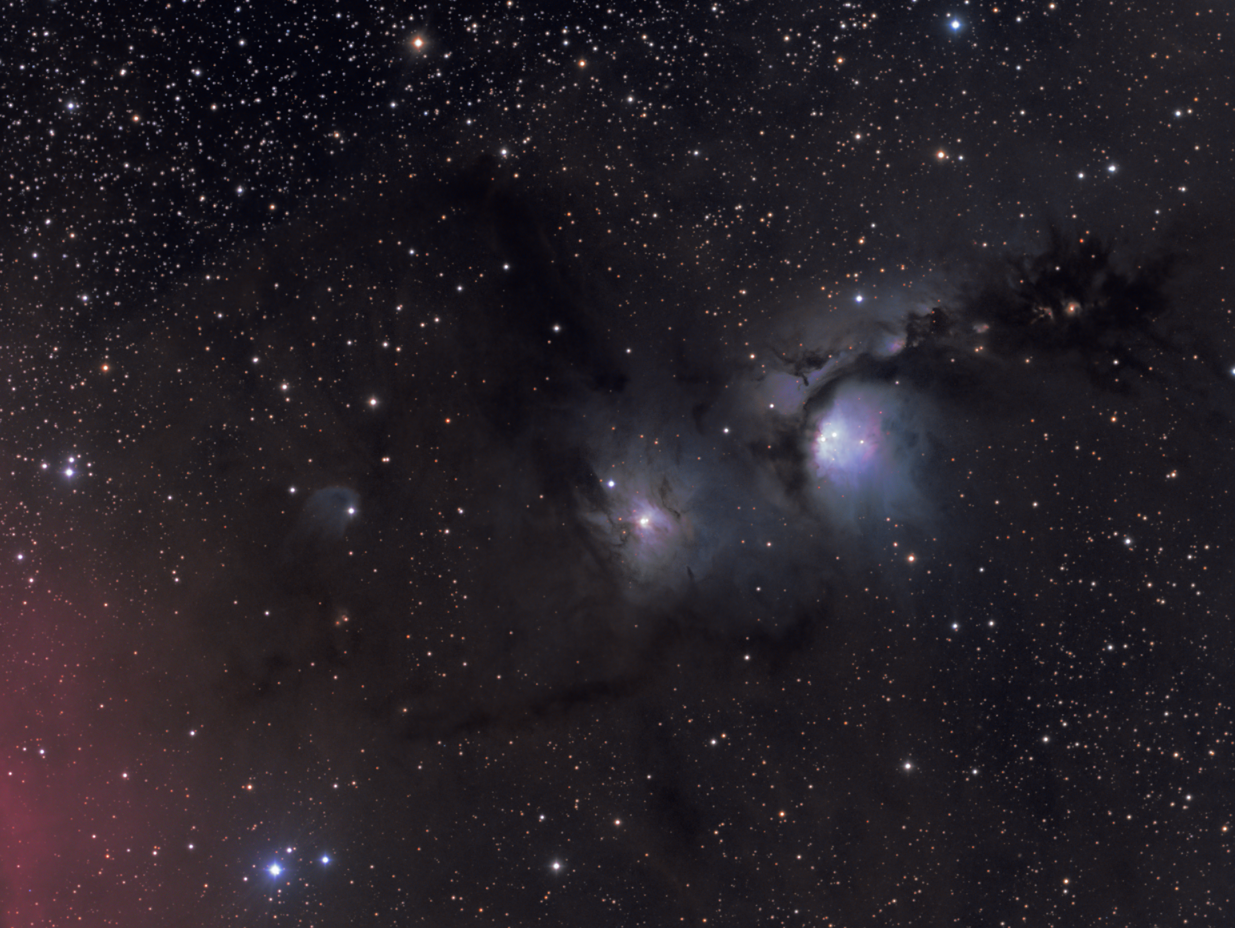
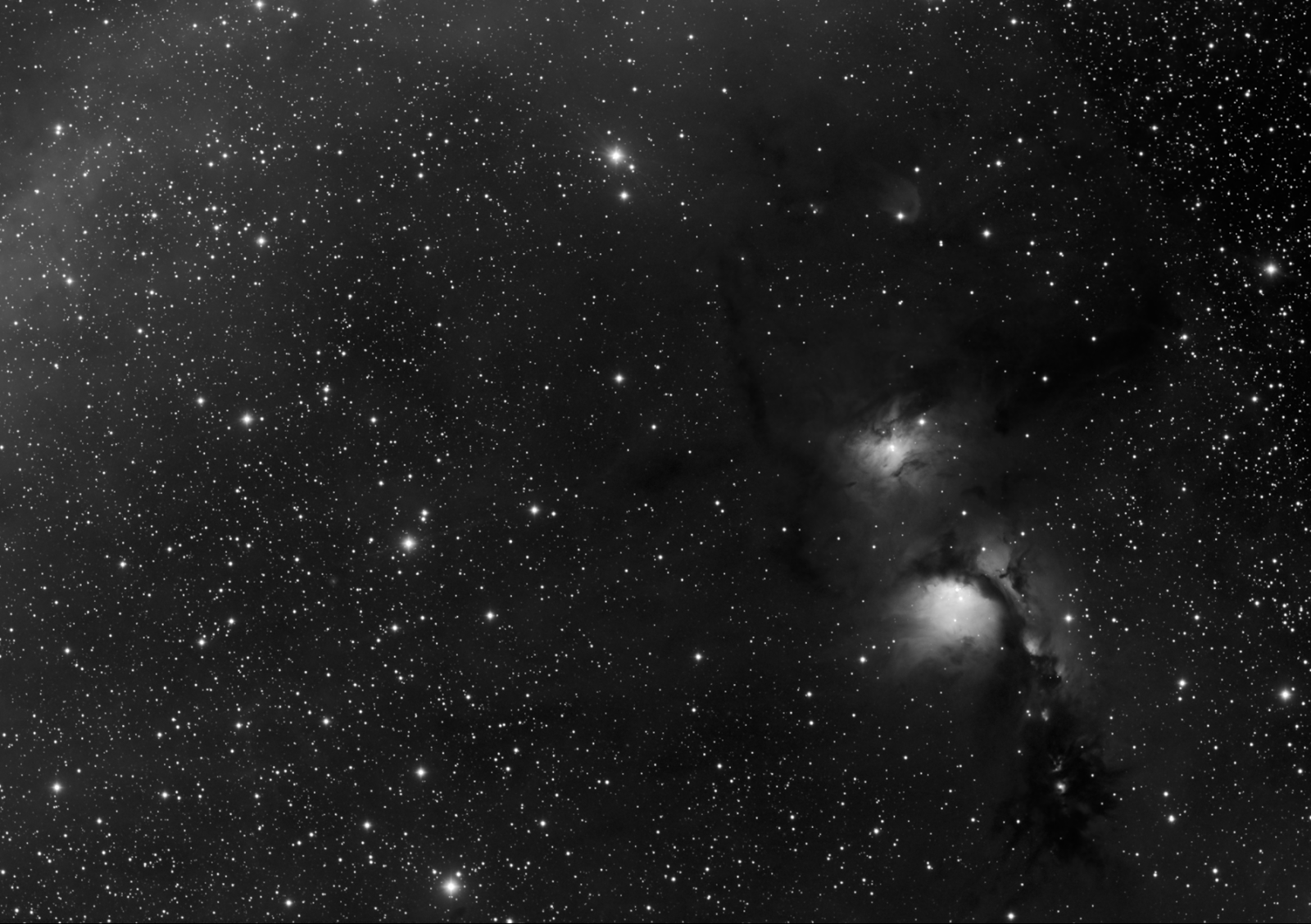
On the night of January 29, I set up the 6" f/5 newt with the Astro Tech Coma Corrector and the SXVF-H9. I wanted a shot of Leo I. But I set up early, and Leo I was not up yet. M78 was positioned just right, so I shot a couple of hours. Leo I came up, and I began to see wispy clouds. Oh, bother. I went ahead, anyway. After a couple of hours, the scope needed a meridian flip. I flipped over and centered Leo I and found an annoying reflection in the the center of the image. It was Regulus, I'm betting, but I have no idea where the reflection was coming from within the telescope. I obviously have some study to do. Anyway, there was no way to avoid the reflection that night, so I just moved to another target, one of my favorite galaxy clusters, Hickson 44. Because of all the moving around, I was only able to get about half the time on each object that I would like, and truthfully M78 needs about ten more hours and a darker sky. Anyway, here are the three images nonetheless, processed, cropped, and otherwise fixed for best presentation. No color here; the H9 is a monochrome and I was shooting for luminance, only. Also, please note that the wispy clouds stayed with me for the rest of the night.

M78, 17x7', a reflection nebula teaming with new stars about 1300 to 1600 light years distant.
Leo I, 14x7', a small galaxy about 800,000 light years away. The bright star to the left (south) of the galaxy's location is Regulus.
Hickson 44, 22x7', a galaxy cluster 72 to 111 million light years away.
Telescope: Orion 6" f/5 Imaging Newtonian with GSO Coma Corrector (effectively at f/5.5)
Camera and Exposure: SXVF-H9
Filter: IDAS-LPS2
Guiding: SX Lodestar, SX OAG
Mount: Takahashi NJP
Software: Nebulosity, Maxim DL, Photoshop CS3
Location: The Woodlands, TX