October 10, 2012

M42 Trapezium (Sept. 22, 2012)


The lovely little cluster called the Trapezium lies at the heart of M42, the Great Nebula in Orion, and is named after the shape made by its brightest stars.  M42 and the Trapezium are one of the grandest sights in the sky and are subjects for serious study.

The cluster's stars are close together, literally as well as apparently.  They appear so close that they were once thought to be one star, Theta Orionis.  As astronomers over time split the star into more and more components, they named the components with letters.  The brightest star in the cluster is Theta Orionis C.  It is very bright, very hot, and generates most of the ultraviolet radiation that makes the gas around it glow.  In the image, the star at the top of the Trapezium is D.  The two brighter other stars that make up the trapezoid, going from left to right, are A and B.  Here is a close crop of the cluster:

As more components were discovered, more letters were used.  The semi-bright star between A and B (and just to the right of A) is E.  The star just above C is F (which looks elongated; actually there are two stars there).  The star just below D is G, and directly below G is I.  Moving to the lower left of I is H, which is just below C and to the left of A.  Next to H, to H's immediate left, is another star, and I have no idea what it's name is.  Nor do I know the names of the other, nearby stars.  Actually, I was surprised to see so many here.  But this is not anywhere close to all the stars in the cluster.  Many of them shine in wavelengths other than those allowed by the two filters that I used to take this image.  I should explain.

One of the cool things about this nebula is that stars in it are still forming.  There is still a lot of dust obscuring stars that have formed, and the stars do not all glow with the same intensity at all wavelengths.  When we take pictures, we often use different filters that cut out all but a few wavelengths.  This allows us to focus only on the gases that light up the nebula, to the exclusion of almost all other light (including streetlights in front of my house).  For example, this image records light with a wavelength of 656.28 nm.  At that wavelength we find light emitted by ionized hydrogen.  Very near it we also find the light of ionized nitrogen, and my filter (called an h-alpha filter because it focuses on the hydrogen emission) just happens to pass light from a band 12 nm wide.  It is wide enough that it also picks up the nitrogen signal.  This image also records light taken through another filter that allows the wavelengths of 495.9 nm and 500.9 nm, and this light is emitted by ionized oxygen.  This filter is often called an OIII filter.  The h-alpha line is in the red part of the spectrum, and the OIII lines are green, but I've mapped OIII to blue here, also, because blue and red make a better picture.  So here you see the stars as they shine at those wavelengths.

But look at this next image.  I also took an image through an SII filter, which allows in light of ionized sulfur, at wavelengths of 671.6 and 673.1 nm.  The image is quite different:
More stars appear, and they are brighter.  Why is that so?  It may be because these stars radiate more light from ionized sulfur than from hydrogen, nitrogen, or oxygen.  I suspect that is the case.  Notice that stars G, H, and I are dimmer in this SII image, and that F is not elongated.  

The best way to see this cluster, though, is at infrared wavelengths.  Not until wavelengths of 750 nm do we reach the infrared.  Infrared light cuts through the dust, so an infrared image shows hundreds more stars in the area.  An example from the Hubble Space Telescope is here.  How cool is that?  On the other hand, when the Hubble records in h-alpha, nitrogen, and OIII, as I did, it picks up the same stars I do in the first image above (and a few more with Hubble's better resolution and bigger aperture, of course, but nothing like the infrared), as here.

Anyway, I took these images of the Trapezium from my backyard, in about an hour's time.  The stars are so bright that only short exposures would keep the stars small enough to remain separate.

Telescope: Orion 254mm f/4.7 Newtonian and Astro-Tech Coma Corrector (eff. at f/5.17)
Camera and Exposure: SXVF-H9 (H-alpha: 11x30"; OIII: 15x30"; SII: 15x30"), T-shirt flats
Filter: Astronomik 12nm Ha, OIII, and SII
Guiding: SX Lodestar and SX OAG
Mount: Takahashi NJP
Software: Nebulosity, Maxim DL, Registar, Photoshop CS3
Location: The Woodlands, TX

September 29, 2012

NGC 281 Bi-Color (September 2012)

Here is the Pacman Nebula again, a closer view.  The H-alpha data shown earlier this month falls naturally in the red part of the spectrum.  To this I have added OIII.  Ionized oxygen is green, but it is weaker than the H-alpha.  In this image, I have used H-alpha for red, OIII for blue; I combined this data (20% Ha, 80% OIII) to create a third data set, which I used for green.  This is a slightly false color, but I think it is easy on the eyes and shows the data well.

Telescope: Orion 254mm f/4.7 Newtonian and Astro-Tech Coma Corrector (eff. at f/5.17)
Camera and Exposure: SXVF-H9 (H-alpha: 1x900" + 12x1200"; OIII: 15x1200"), T-shirt flats
Filter: Astronomik 12nm Ha and 12nm OIII
Guiding: SX Lodestar and SX OAG
Mount: Takahashi NJP
Software: Nebulosity, Maxim DL, Registar, Photoshop CS3
Location: The Woodlands, TX

September 26, 2012

M31, the Andromeda Galaxy, with M32 and M110 (Sept. 19, 2012)


Behold the great Andromeda Galaxy!  In this image, you also see galaxies M32 (the small one, upper left) and M110 (the larger one, lower right).  M32 and M110 are satellite galaxies of M31.  Also visible at lower left is a large group of young stars in the spiral arm or ring of the large galaxy.  That group and the outer areas of the galaxy are bluer because the stars in them are younger and hotter than the stars in the galaxy's central bulge.

Telescope: SV80ED (and William Optics 0.8x II fr/ff (eff. at f/5.6))
Camera and Exposure: SXVF-H9C (47x420"), Alnitak Flat-man flats
Filter: Hutech IDAS-LPS2
Guiding: Meade DSI Pro & Hutech 50mm
Mount: Takahashi NJP
Software: Nebulosity, Maxim DL, Photoshop CS3
Location: The Woodlands, TX

September 21, 2012

Merope, AT111EDT First Light (Sept. 20, 2012)


Here is a closeup on Merope, one of the Pleiades (also known as Subaru or Seven Sisters, or M45).  The Pleiades are passing through a cloud of dust.  Reflected starlight from the group shines on the dust in blue.  Because the cluster of stars is only about 390-440 light years distant, it appears as a cluster to anyone looking up in a dark sky at the constellation Taurus.

This is first light with an AT111EDT.  I am the second owner, but the scope was well cared-for.  I am excited to fit this scope out for convenient imaging as a replacement for the 6" Newtonian.

Telescope: Astro-Tech AT111EDT (and William Optics 0.8x II fr/ff (eff. at f/5.6))
Camera and Exposure: SXVF-H9C (35x240"), Alnitak Flat-man flats
Filter: Hutech IDAS-LPS2
Guiding: Meade DSI Pro & Hutech 50mm
Mount: Takahashi NJP
Software: Nebulosity, Maxim DL, Photoshop CS3
Location: The Woodlands, TX

September 8, 2012

IC 1590 & NGC 281 (Sept. 6, 2012)

I've always wanted to get closer to the cluster at the center of this nebula.  A clear night this week presented an opportunity.  I had some trouble with the 254mm Orion Newtonian early on: a poorly installed dew heater was warping the secondary.  When I realized what the problem was and shut off the dew heater, the field quickly flattened out.  By that time, NGC 281 was just coming over the trees.  This is my first image of the nebula with the big Newt, and the first time I've shot H-alpha through the big scope.  I don't think it will be the last time.  This is also first light since installing a Protostar tubeliner inside the scope.

NGC 281 and the open cluster in the center of the image, IC 1590, are about 9,500 light years away.  The nebula is bright because the stars in it are bright.  The nebula is an emission nebula, which means that the gas of the nebula (hydrogen in this image) is excited by the ultraviolet light of the stars in the cluster.  The cluster and nebula are a package deal.

What I like about this nebula in particular are the clumps of gas and dust in front of it.  The clumps are being worn away by starlight, but several of them stand out against the face of the cloud, including the long river near the cluster and several little globules in the upper right.

It's a grand sight!  I recommend clicking on the full resolution link above, toggling F11, and panning about.

Telescope: Orion 254mm f/4.7 Newtonian and Astro-Tech Coma Corrector (eff. at f/5.17)
Camera and Exposure: SXVF-H9 (1x900" + 12x1200"), T-shirt flats
Filter: Astronomik 12nm Ha
Guiding: SX Lodestar and SX OAG
Mount: Takahashi NJP
Software: Nebulosity, Maxim DL, Photoshop CS3
Location: The Woodlands, TX

September 3, 2012

Testing a TSA-102 (September 2012)

I am fortunate to have a friend with a Takahashi TSA-102.  I asked her advice regarding the scope, and she offered to let me borrow it. No kidding.  Taking up this very generous offer, I was pleased a few nights ago to gather 20x4' hours worth of data in Cygnus.  I wasn't even sure where the scope was pointing.  I just wanted to see what the image looked like and how the processing went.

Behold!  What I like most about this scope is the shape of the stars.  Wow!  They are perfect.  The colors are also nice.  This image was gathered with the SXVF-H9C and a Celestron LPR filter that happened to be lying about.  I did not bother to calibrate the color, as I do not where this is yet.  But the contrasting colors are easy to see.

August 25, 2012

NGC 185, M51, M16 - Smalls

We've had clouds and clouds lately.  I'm starting to chew on old data.  Two are new images to the blog, however.
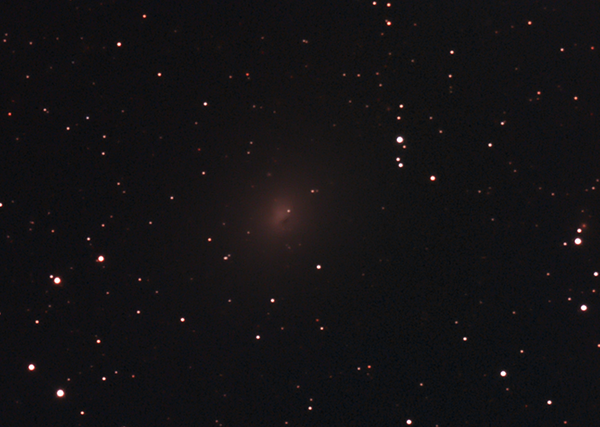
This is NGC 185, a satellite galaxy of the great Andromeda Galaxy, M31.  NGC 185 appears to be full of older, yellow stars and not much action, but a dark lane also appears across the galaxy's face.  Astronomers looking very closely have discovered blue star clusters in the galaxy.  There is new stellar life there yet!  I believe I took this image with the Orion ED80 in January, 2010.

M51 is a spiral galaxy that is best positioned for imaging in winter and spring.  This is a re-process of data gathered with the Orion 10" f/4.7 Newtonian in March of 2011.

This is my last data from Three Rivers.  The nebula is M16, the Eagle Nebula.  The eagle shape is hard to see in the image, as the data is not deep.  But if you look closely you can see in the heart of the nebulosity the pillars of creation made famous by the Hubble Space Telescope.  This image was shot with the SV80ED, mounted on the EM-10, unguided.  It is a stack of forty 3-minute images.

All of these images were taken with the SXVF-H9C.