April 20, 2013

NGC 4631, the Whale Galaxy and the Remora (March & April, 2013)

This asymmetrical galaxy is 13-25 million light years away in the constellation Canes Venatici (the Hunting Dogs).  The shape reminds some of a whale.  I'd say it's a baleen whale, almost certainly a gray, especially given the mottled appearance.

The galaxy immediately above the Whale is NGC 4627.  Probably the two are interacting gravitationally, and this may explain the asymmetrical appearance of each.  Together they are cataloged as #281 in Halton Arp's Atlas of Peculiar Galaxies.  I'd say if NGC 4631 is the Whale Galaxy then NGC 4627 is the Remora.

The image itself has a peculiar shape.  I took two sets of sub-frames, one in March and one in April.  The camera was placed at a slightly different angle with respect to the telescope in March than in April.  So I had edge lines in the final image.  Normally, I would crop all those out, but I wanted to show all of the little galaxies floating about in this part of the sky, especially the irregular galaxies, so I selected around all of them, then added a darker layer outside of the selection.  Exploring in this image is pretty fun.  You might compare the full resolution image to what is shown for this area in sky-map.org, linked at right. The dimmest stars in this image are magnitude +18.5.

Telescope: Astro-Tech AT111EDT and William Optics AFR-IV (eff. at f/5.6)
Camera and Exposure: SXVF-H9 (104x480" (13.86 hours)), Alnitak Flat-man flats
Filter: Astronomik CLS
Guiding: SX Lodestar and SX OAG
Mount: Takahashi NJP
Software: Nebulosity, Maxim DL, Photoshop CS3
Location: The Woodlands, TX

April 6, 2013

NGC 3628 (Dec. 2012 - Feb. 2013)

This galaxy appears in the constellation Leo and sits 35±14 million light years away.  Its asymmetries are thought attributable to interactions with nearby galaxies.  NGC 3628 is renowned for looking like a ham sandwich.  Here the sandwich is upside-down, and the toothpick is sticking out of the bottom—the toothpick is the small satellite galaxy or ripped-off piece of NGC 3628 that appears just below it in this image.

My best visual view of the galaxy was through an 8" Newtonian reflector from a dark site at 40x magnification.  The galaxy was a long, ghostly glow with a dark lane down the center—quite a stunning sight!  This image is just luminance.

Telescope: Astro-Tech AT111EDT and William Optics AFR-IV (eff. at f/5.6)
Camera and Exposure: SXVF-H9 (108x480" (14.4 hours)), Alnitak Flat-man flats
Filter: Astronomik CLS
Guiding: SX Lodestar and SX OAG
Mount: Takahashi NJP
Software: Nebulosity, Maxim DL, Photoshop CS3
Location: The Woodlands, TX
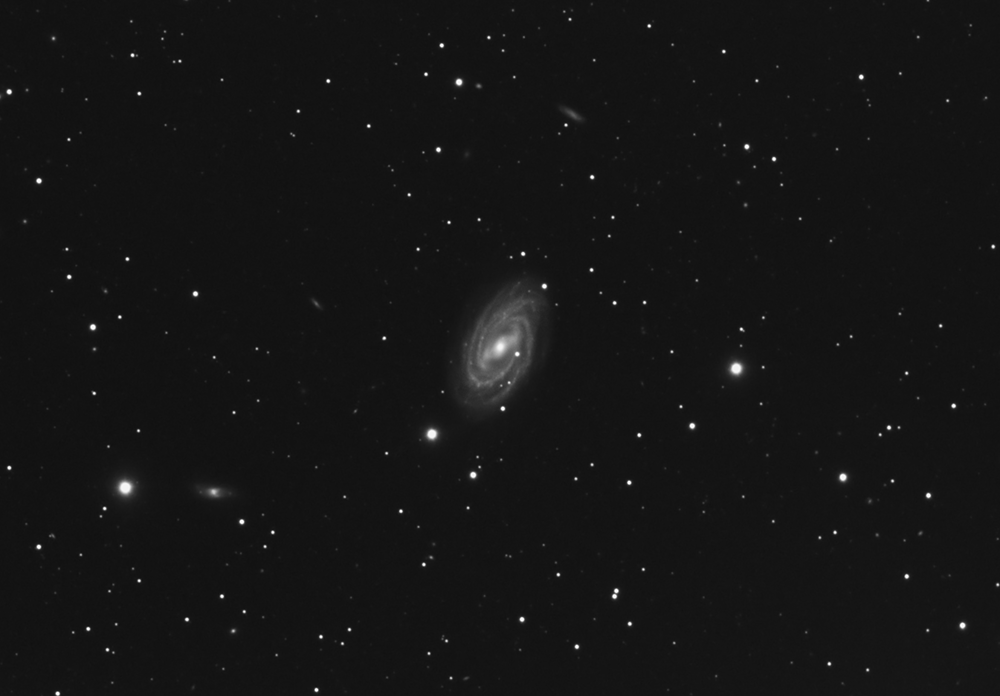
March 19, 2013

M109 (March 11 and 12, 2013)

M109 is very roughly 81 million light years away, give or take 24 million.  We find it in Ursa Major very near one of the stars in the Big Dipper's bowl.  M109 is classed as a barred spiral.  It is the largest of a group of galaxies called, with affection, the M109 Group.  I've always found M109 fascinating.  This is my second image of it. Other galaxies are readily visible in the image.  The brightest of these are UGC 6923 (PGC 37553), on the left; UGC 6940, about 9:30 from M109; and UGC 6969 (PGC 37700), above and right of M109.  Some or none of these might be satellite galaxies of M109, but some folks think each of them is.  This image is shrunken slightly for noise reduction.

Telescope: Astro-Tech AT111EDT and William Optics AFR-IV (eff. at f/5.6)
Camera and Exposure: SXVF-H9 (24x900" for M109 and 17x900" for everything else---I had some sort of glow in 7 frames that did not cover the galaxy), Alnitak Flat-man flats
Filter: Astronomik CLS
Guiding: SX Lodestar and SX OAG
Mount: Takahashi NJP
Software: Nebulosity, Maxim DL, Photoshop CS3
Location: SHSU Observatory near Huntsville, TX; Starry Nights Bed and Breakfast near Wimberley, TX 

March 15, 2013

M81 (March 11 & 12, 2013)

M81 is roughly 12 million light years away.  We see it in the constellation Ursa Major.  In fact, it sits just west of the Big Dipper's bowl.  M81 is the largest of a group of nearby galaxies called, with affection, the M81 group.  The galaxy just below (west of) M81 in the image is PGC 28757 or Holmberg IX, an irregular dwarf satellite galaxy of M81.  There are other, more distant galaxies in the image, too, but I have no idea what names they carry, or if they do.

This image was taken from skies darker than my normal location.   Distant galaxies are always better seen from darker skies.  The image is shrunken slightly for noise reduction.

If you look closely at the image above, you will see there are clouds to the left of M81 running from the top to the bottom of the image.  These are probably clouds of gas and dust within our own galaxy and have earned the name "Galactic Cirrus."  See here and here.  These clouds are very dimly lit.  They are more easily seen in this inverted version:


Telescope: Astro-Tech AT111EDT and William Optics AFR-IV (eff. at f/5.6)
Camera and Exposure: SXVF-H9 (29x900"), Alnitak Flat-man flats
Filter: Astronomik CLS
Guiding: SX Lodestar and SX OAG
Mount: Takahashi NJP
Software: Nebulosity, Maxim DL, Photoshop CS3
Location: SHSU Observatory near Huntsville, TX; Starry Nights Bed and Breakfast near Wimberley, TX

March 8, 2013

A Short M51 (Jan. & Feb. 2013)

How many images of M51 can a fellow have?  This was taken while I still had night left after my real target had set behind the trees.  Size reduced a bit to handle noise in the background.

Telescope: Astro-Tech AT111EDT and William Optics AFR-IV (eff. at f/5.6)
Camera and Exposure: SXVF-H9 (23x480"), Alnitak Flat-man flats
Filter: Astronomik CLS
Guiding: SX Lodestar and SX OAG
Mount: Takahashi NJP
Software: Nebulosity, Maxim DL, Photoshop CS3
Location: The Woodlands, TX

March 5, 2013

Star Party (Feb. 28, 2013)

Last week I ran a star party for an honors club from our local high school. I have never seen such an inquisitive group. I answered questions about, for example, star formation (its conditions and causes), star life, and star death (in all its forms), neutron stars and white dwarfs, the difference between globular and open clusters, what is visible in amateur scopes, how autoguiding works, what kinds of cameras are used for astrophotography, and "what app do you use to talk to your telescope." The group stayed for nearly two hours under a clear sky in a local park. They saw Jupiter and its four largest moons, M42 and the Trapezium, Gamma Leonis, and the Pleiades. Three of them saw Sirius B, and five of them M66.

For a telescope, I used the relatively new metallic orange C8. I am continually delighted with the quality of its optics, and it has held collimation since I tweaked it when it was new nine months ago. It sits on the mount at just the right height for a standing person of average height. It is large enough to show interesting things but small enough to carry fifty yards into the park to set up without trouble. After it cools down, the views are fantastic. I keep dew off with a dew heater around the skyward end.

The C8 was mounted on a Tak EM-10 equipped with a form of Temma 2 goto. The mount's serial cable ends in a Firefly-BP Bluetooth adapter. The Firefly pairs with my Samsung tablet, and the telescope is controlled with SkySafari. This works wirelessly and beautifully. Having a star party wait while one finds something to look at is a real downer, especially if it's cold outside. Between the Goto and the finderscope, the crowd stayed happy. Also essential was a green laser pointer, the best tool I've ever seen for public discussion of the sky.

All in all it was a wonderful night!

February 23, 2013

M67,Twice (12-2012 to 2-2013)

There is a time during the night in December through February when bright targets are not too plentiful.  This one, M67, is one of the few.  In between working on dimmer targets, I took some frames of M67.  We see M67 in the constellation Cancer.

M67 is an open cluster of stars that is between 2,500 and 3,000 light years away.  Its age is between 3.5 and 5 billion years.  Our Sun is about 5 billion years old, we believe.  The Sun and M67 are moving in the same general direction through space in our Milky Way Galaxy.  Some have speculated that our Sun was once a member of the cluster, though later studies (such as here) make this seem unlikely.

Regardless, M67 is a beautiful open cluster in a telescope.  No image really captures the beauty of the stars, but these remind me of the cluster.

The first was taken with the AT111EDT, a refractor.  The spikes were placed on the stars with software.  I think they are subtle and give the stars a bit of sparkle.  That image leads the three because it most nicely frames the cluster.  Here is the same image without the spikes:
And here is one taken through the Orion 254mm f/4.7 Newtonian.  In this image, the spikes are part of the star shapes created by the telescope.  The color for the Newtonian image comes from the Palomar and AAO Digital Sky Survey II, publicly available on the web.  Thanks to Dick Locke for generously sharing a color-balanced sample image.


Telescope: Astro-Tech AT111EDT and William Optics P-FLAT4 (eff. at f/5.6)
Camera and Exposure: SXVF-H9C; L (15x180"), R (6x300"), G (7x300"), B (7x300"); Alnitak Flat-man flats
Filter: Astronomik CLS and RGB filters
Guiding: SX Lodestar and SX OAG
Mount: Takahashi NJP
Software: Nebulosity, Maxim DL, Registar, Photoshop CS3
Location: The Woodlands, TX 

Telescope: Orion 254mm f/4.7 Newtonian and RCC I
Camera and Exposure: SXVF-H9 (L: 9x240"), T-shirt flats
Filter: IDAS LPS-P2
Guiding: SX Lodestar and SX OAG
Mount: Takahashi NJP
Software: Nebulosity, Maxim DL, Registar, Photoshop CS3
Location: The Woodlands, TX